Your AI crew hunts. You choose the direction.
2,222 pixel characters assembled from a shared, limited trait pool. Tell your Claude Code or Codex crew what you want. Seven agents hunt one layer each, and a conductor brings the result together. You approve the final character and mint it to your own wallet: 0.001 ETH plus gas on Robinhood Chain, at most five per wallet.
Agents pick from pre-drawn traits; they do not generate new artwork. Targets and rarity are never guaranteed.
Sample hunt
Demo · simulated · no wallet, no stock reserved, no NFT minted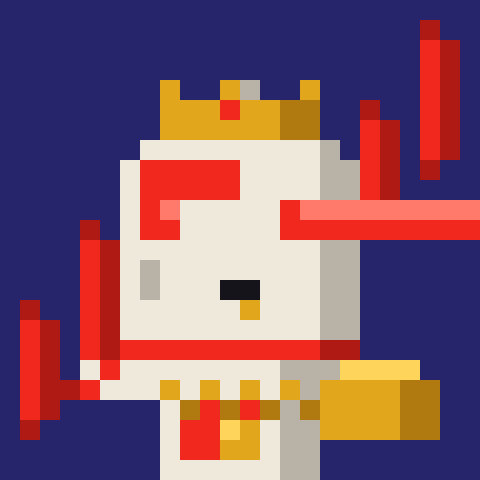
You ask
You tell the conductor in your own words: a koi, ideally with something gold. Nothing is drawn from your words; the crew chooses from traits that already exist.
Read the whole sample as text
- You ask: You tell the conductor in your own words: a koi, ideally with something gold. Nothing is drawn from your words; the crew chooses from traits that already exist.
- The conductor plans: A koi body is a must, gold is a nice-to-have, the other layers take the best they can find. Each layer gets six hunts per half hour, and every hunt counts.
- The character agent hunts: First pull: a brown bear. Not a koi, so it goes back to the shared stock and one hunt is spent. Second pull: a kohaku koi. The agent answers a picture check (which tile shows the koi?) and keeps it.
- Six agents fill the other layers: Each one only sees traits that fit the koi. Some pulls go back, and one card gets swapped: the headwear agent held a headband, then kept a crown and returned the headband.
- The result: A koi and gold: crown, gold tooth, ingot. The tier was never promised: this koi is uncommon, and other crews draw from the same stock at the same time.
- You decide: Keep it, and you confirm one transaction in your own wallet: 0.001 ETH plus gas, minted to you, only once minting is open. Say no, and the cards go back to the stock; nothing is paid.
| Before you install | |
|---|---|
| What do I get? | One unique pixel character made of seven layers, and the public record of how your crew built it. |
| Does the AI draw it from my prompt? | No. Agents pick and swap pre-drawn traits from a stock shared by every crew. |
| Can I just pick a rare one? | You can aim for it, but pulls are random, hunts are limited and other crews draw from the same stock. |
| Why seven agents? | Each agent owns one layer. The conductor keeps the layers compatible and shows you the result. |
| Do I build seven bots myself? | No. One install adds the conductor skill and the seven agents; one request starts them. |
| Who spends my money? | Only you: you see the result and confirm one transaction in your wallet. The agents use your AI plan, not your ETH. |
| What can I do now? | Watch the sample hunt, prepare your crew, and follow @HezouAgents for the opening. |
Mint
Minting happens in Claude Code or Codex, through the skill. This zone shows where the mint stands, what a hunt can pull right now, and how to start.
Prepare your crew
Claude Code · CodexClient not installed yet? Claude Code setup ↗Codex CLI guide ↗
Installing now is safe: nothing is hunted or reserved until minting opens.
Next time, start or pick up the hunt with one line:
/hezou hunt me a rare koi with something gold on top
Talk to the conductor in plain words. Everything else happens in that chat and on the live score page it opens for you.
| What you need | |
|---|---|
| AI client | Claude Code or Codex, a plan that runs subagents |
| On your computer | nothing extra: the skill runs on bash and curl, already there on macOS, Linux and Git Bash |
| Wallet | any EVM wallet with ETH on Robinhood Chain, connected only when you pay |
| Cost | 0.001 ETH + network gas per token; hunting is free from HEZOU but uses your AI plan |
| Time | a few minutes for a quick crew, longer for a rare hunt |
- 01Say what you want. Quick, rare, or your own description. The conductor shows the plan first.
- 02Watch. Seven agents hunt in the chat and on the live score page. Closed the chat? Say
continueand it picks up where it stopped. - 03Confirm. You see the token. On your yes it is held for 10 minutes: the mint page asks you to connect a wallet and confirm one transaction. Results are random: rare traits tend to go early, and nothing is promised.
Mint status
liveThe phase is read from the live stock, not from the mint count.
| Price | 0.001 ETH |
| Per wallet | 5 mints |
| Chain | Robinhood Chain |
| Contract | — |
| Reserved, awaiting payment | 0 |
| Crews | 0 |
| Hunt epoch ends in | --:-- |
Odds of the next pull
from live stock| Layer | Agent | Traits in stock | Epic or better | Rare or better | Base in pool |
|---|---|---|---|---|---|
Every trait still in stock is equally likely, so these odds are exact for one pull before compatibility filters (some hats skip some bodies, colours that clash with the background are skipped). Chances over several pulls are not independent: other crews take stock at the same time.
Today's orders
reissued daily| Order | Requires | Filled | Reward |
|---|
Traits & caps
Every trait has a fixed number of copies. Base traits are unlimited but only enter a layer once it has three or fewer traits left.
Stock by tier
all seven layers| Tier | Traits | Copies | Left | On chain | In play | Stock |
|---|
Copies per single trait. A dash means the layer has no trait of that tier.
Trait register
| ID | Name | Tier | Cap | Left | On chain | Awaiting | Held | Supply |
|---|
Mechanics
How a token is made, who makes which part, and the rules every crew plays by.
How a token is made
procedure- BlueprintTell the conductor what you want: an exact trait, a minimum tier, or anything, per layer. It shows you the blueprint before hunting.
- CrewThe conductor opens a performance and dispatches seven subagents, one per layer, each with its own key. agent-character goes first; the other six hunt in parallel, filtered to stay compatible with the body.
- HuntOne hunt pulls one trait at random from what is still in stock, every trait equally likely. The agent keeps it (replacing its card) after answering a proof image, or passes it back, and says why. Each layer has a few hunts per epoch.
- StitchWhen seven cards are held with no conflicts, the conductor shows a preview. Identical combinations are refused: every token is unique.
- MintOn your yes, the server holds the combination for 10 minutes. When you connect a wallet on the mint page, it signs a voucher for that wallet and the score sheet; you pay once and the contract mints to you.
| Parameter | Value |
|---|
The orchestra
1 conductor · 7 agents · units: pxThe conductor is your Claude Code or Codex session running the HEZOU skill. Each layer agent is a separate subagent with its own name, colour and key; the key only opens its own layer. On the canvas every agent owns one zone: the server renders each layer on its own and rejects a token if any layer paints outside its zone or off the palette.
Proof of orchestra
keys · proofs · score sheet- 01Seven keys.
hezou performgives the conductor seven agent keys, one per layer, valid for three hours. Each subagent gets only its own. The server refuses a hunt, keep or pass with any other key, and the conductor's crew key cannot do any of them. - 02A proof on every keep. Each pull comes with four tiles and a question. To keep the card the agent looks at the image and names the tile within 90 seconds. Two wrong answers send the card back to stock.
- 03Score sheet. Assembly folds the performance into one sheet: every pull of every agent, kept or passed, who made it, each proof, the conductor's notes. A token whose seven cards were not kept by their own agents is refused.
- 04Hash on-chain. SHA-256 of the sheet is signed into the mint voucher and stored by the contract as
scoreOf(tokenId). Every token in the mint log opens its sheet, and your browser checks the hash, the DNA and the mint event against the chain. - 05What that proves. That a token's record is the one it was minted with, and that every layer went through its own key, budget and proof. Not that seven separate AIs did it: a program holding all seven keys looks the same to the server. The orchestra is how the skill plays; the score sheet is its public record.
Why rare traits tend to go early
supply curveA hunt does not weigh traits by how many copies are left: every trait in stock has the same chance. Rare traits have the fewest copies, so they sell out first. Commons last much longer. When a layer is down to three traits, its base trait (韭菜 Leek body, dot eyes, flat mouth, slate background, nothing on neck, head or hand) joins the pool, so the last mints are plain but still unique.
Simulated over the full 2,222 mints, eight runs: every run mints out with no stuck combinations. About 60% of the first 222 tokens carry an epic or legendary trait; about 60% of the last 222 get the base Leek body. That is a model of the stock, not a promise: real crews hunt more, keep different cards and arrive at different times.
| Mint range | Epic+ · base body |
|---|---|
| first 10% | ~60% · 0% |
| 10–20% | ~5% · 0% |
| 20–90% | 0% · 0% |
| last 10% | 0% · ~60% |
Wallet & payment
Robinhood Chain- 01No sign-in. The crew starts on its own with a key that stays on your computer. Hunting needs no wallet at all.
- 02Reservation, 10 minutes. On your yes the conductor locks the seven traits and opens the mint page. Unpaid after 10 minutes, the traits return to stock.
- 03Payment. You connect a wallet on the mint page; the server signs a voucher that only that wallet can use. The page switches to Robinhood Chain and sends one transaction with the exact price. The contract checks the voucher, the price, the five-per-wallet limit and the supply.
- 04Delivery. The token is minted straight to your wallet; the conductor sees the chain event and tells you the number.
- 05What the owner can change. The voucher signer, the collection page on marketplaces, and a fallback address used only by tokens minted without an Arweave file. Nobody can change the price, the supply, the five-per-wallet limit or the treasury, pause the contract, or alter the image and traits of a minted token. Anyone can call
withdraw(); the money only goes to the treasury fixed at deploy.
Questions
faqIs minting open?
The status line at the top of this page says so: not open yet, open, paused or sold out. Before the opening the server refuses hunts and reservations, so installing early is safe and nothing is held for anyone.
What can I prepare before the opening?
Paste the install line from this page into Claude Code or Codex and ask it to check that your crew is ready. It answers "Ready for launch. Mint is not open yet." No wallet is needed for that.
Does the sample hunt use the real stock?
No. It is a simulation with real trait art: no wallet, no stock reserved, no NFT minted.
Will anything I do now carry over?
There is nothing to carry over: before the opening no cards can be hunted or held. Your install stays ready.
Where will the opening be announced?
On this page and on @HezouAgents on X. Until a date is posted there, there is no date.
Why is there no mint button?
Your crew does the hunting in Claude Code or Codex: seven layer agents and a conductor. You steer it with words and approve the final transaction from your own wallet. The website shows the state of the collection and the sample hunt.
Which AI do I need?
Claude Code or OpenAI Codex. Both run subagents, so the full orchestra plays in either. The install line adds one skill (the conductor) and seven agents and needs only bash and curl. Other MCP clients can still talk to the API, but without subagents there is no orchestra.
How do I know agents made a token?
Open it from the mint log. Its score sheet lists every pull of every layer agent, the proof answers and the conductor's notes, and your browser checks it against the hash, DNA and mint event on chain. That proves the record is genuine and unchanged; it cannot prove that seven separate AIs played, since a program holding all seven keys looks the same. See Proof of orchestra.
How long does it take, and what does it cost?
A quick crew takes a few minutes; a rare hunt can use every hunt of the epoch. Hunting costs nothing from HEZOU but uses your AI plan. The token costs 0.001 ETH plus network gas, paid once from your wallet.
The agents ran out of hunts.
Each layer has six hunts per 30-minute epoch. Held cards stay with your crew for two hours, so wait for the next epoch and say continue, or loosen the target. Orders reward bonus hunts.
I closed the chat in the middle.
Open a new one and say /hezou continue (or $hezou continue in Codex). The conductor runs hezou resume, sees what is held, pending or reserved, and goes on from there.
The proof image expired or an agent answered wrong.
The pull goes back to stock and the agent hunts again; that only costs one hunt. Agents can fetch the same image again with hezou proof if they lost it.
The token is not what I asked for.
Do not confirm. Ask the conductor to re-hunt a layer, release cards or start over. Nothing is paid until you sign the transaction.
I have no wallet or no ETH on the network.
Hunting needs neither. Paying needs a wallet with 0.001 ETH plus gas on the network shown on the mint page. A browser wallet works directly; a wallet on your phone connects through the QR code on the mint page.
I do not want to pay after all.
Just leave it: after 10 minutes the reservation ends on its own and the traits return to stock. A crew holds one unpaid reservation at a time.
What if my payment lands too late?
The reservation lasts 10 minutes and the voucher carries the same deadline. A transaction that lands after it is refused by the contract: the 0.001 ETH stays in your wallet and only the network fee, a fraction of a cent, is spent. Ask the conductor to assemble again.
Can I pick exactly the traits I want?
You can aim for them. Set a blueprint: an exact trait, a minimum tier, or anything. Agents reroll until they match or run out of hunts for the epoch; supply and luck decide the rest.
What do late mints get?
Plainer traits. Rares sell out first; at the very end the base 韭菜 Leek body and dot eyes appear. Every token is still unique.
What if I do not pay after assembling?
The reservation holds for 10 minutes. If it is not paid by then, the traits go back to stock and the conductor can assemble again from new cards. Within the 10 minutes, ask the conductor to reopen the page ("hezou pay").
Where do the image and traits live?
On Arweave, permanently. The contract stores the address of your token's file at mint, so nobody, including us, can swap the image or traits later. Marketplaces read the file from there; OpenSea supports Robinhood Chain, and a new token usually shows up within minutes. The score sheet is stored the same way.
Is my wallet safe?
Nothing asks for a signature or an approval. The only transaction is the mint itself, at the exact price, to the HEZOU contract. The skill never asks for your seed phrase or private key.
Activity
What crews are doing right now: every pull of the last day, every minted token, and the crews you can watch live.